
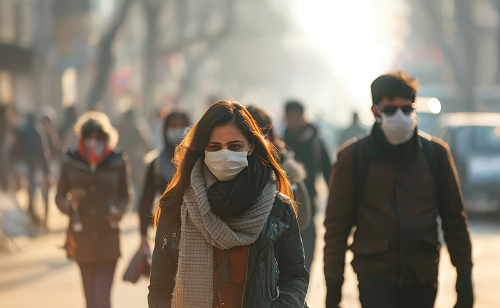
We all know what happens as soon as the festive season approaches: schools shut down, work-from-home advisories are issued, and GRAP is implemented. Unfortunately, people are forced to stay inside their homes, and it’s even worse for someone already suffering from asthma or other respiratory diseases.
Year after year, India chokes from October to December, as the AQI crosses 490+. Children can’t celebrate outside, you have to wear a mask every time you step out the door, and still suffer from burning eyes, scratchy throat, and skin irritation.
Authorities are already preparing. On September 15, CAQM directed Delhi, Haryana, Rajasthan, and Uttar Pradesh to ensure schools do not schedule physical sports activities or competitions in November and December. The order protects children from exposure on the worst days. It’s a band-aid solution for a much bigger problem: the toxic air all of us are going to breathe for the next three months.
Where All This Smoke Comes From
Delhi and the entire Indo-Gangetic Plain sit like a bowl, guarded by the Himalayas to the north. Winter cools the ground, and a layer of cold air traps pollutants beneath it. Meteorologists call this a temperature inversion. Across Delhi NCR, several sources add to this trap:
- Stubble burning accounted for 22% of the alarming PM 2.5 levels in November last year.
- Around a dozen coal-fired plants sit within 300 km of the city, producing about 13% of SO2 emissions across the NCR airshed.
- Delhi alone has over 25,000 registered industrial units, and informal units push the real total closer to 1,00,000.
- Overburdened landfills crossed capacity limits years ago yet take in more waste every day.
- Vehicle exhaust and construction dust add to the load all year.
- Smoke from Diwali firecrackers led to a 3x spike in PM2.5 levels last year
Staying Indoors Was Never the Fix
Advisories to stay indoors assume the air inside is safe and clean. University of Chicago researchers measured indoor air in thousands of Delhi homes and found that indoor PM2.5 is actually worse than the values reported by the government monitors. Indoor PM2.5 spikes in the morning and evening, right when most households are cooking.
A festive home is likely to have even worse air quality, as kitchens run overtime for festive cooking. Add to it the incense and diyas burning every evening, off-gassing from paint and new furniture bought for the season, and CO2 building up in a room full of relatives. So the air affecting your family during festive seasons isn’t the air outside your windows. It’s the air trapped inside your own living room, and almost nobody is measuring it.
The Cost Shows Up in Hospitals
Delhi doctors report a 20-30% jump in respiratory patients during peak pollution, including first-time cases and young adults. Six major central hospitals logged more than 2.04 lakh emergency visits for acute respiratory illness between 2022 and 2024, and around 30,000 of those patients were admitted. A study in The Lancet Planetary Health estimated that air pollution cost India US$36.8 billion in lost output in 2019, about 1.36% of GDP, and accounted for 17% of deaths that year.
What Actually Needs to Change
Rather than treating air pollution as a serious public health concern with high economic cost, we treat air pollution like a seasonal inconvenience. It has now become the new normal, where every October to December schools shut down, construction stops, holiday trips get cancelled, odd-even returns, and businesses lose productive hours. Nobody is surprised anymore, and that is the real problem.
Pausing school sports for two months is not the solution, and neither is stopping stubble burning alone. Finding sustainable alternatives for farmers matters, but geography plays a big part in the pollution equation too. Delhi sits in a bowl, and winter temperature inversion traps everything we emit, from stubble to industry, landfills, and traffic. That is why it returns every year, and East India could face the same pattern in the coming years.
Real change starts months earlier. Pollution controls that begin before the AQI crosses 400, and multiple stakeholders acting together, are more likely to improve outdoor air quality. That work takes time.
Until then, you can fix the air in your home and protect your family before the festive season peaks. O2 Cure was built for exactly this. Before installing anything, the team checks your space and builds a system that fixes indoor air at the source, instead of just filtering what is already in the room.
Book an indoor air audit with O2 Cure before the festive season peaks: https://o2cure.in/
